



































.svg)




























.svg)












Kevin Gemeroy
Kevin is founder and president of Dynamic Computing. For more than two decades, he has been a trusted technology partner for Seattle-area businesses and nonprofits.
Who We Are
Industries
Solutions
Service Areas
Resources
One of the biggest mistakes business leaders make is assuming AI adoption and usage is something their organization can wait on.
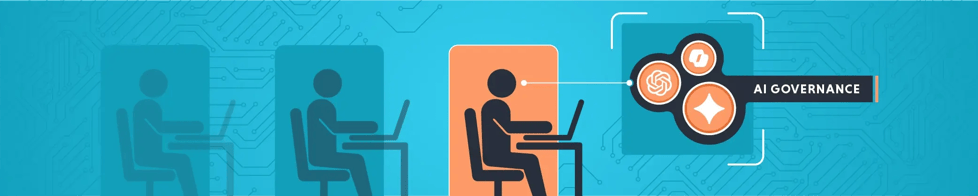
In reality, that train has already left the station. Chances are, your employees are already using tools like ChatGPT, Microsoft Copilot, Claude, Gemini, and dozens of niche AI platforms to save time and reduce friction in their work.
The term for this is “Shadow AI,” and while it often happens with good intentions—say, a desire to work faster and better—your business is flirting with some serious risks if you don’t get in front of it.
Without guardrails around AI in your organization, any or all of these things can happen:
Ignoring these risks doesn’t make them disappear. It only makes them harder to manage later. That’s why business leaders need to approach the Shadow AI issue not with panic, but with pragmatism.
The goal when dealing with Shadow AI shouldn’t be an outright ban on AI usage. Instead, you should focus on creating a framework for safe, intentional, and productive AI adoption.
And building out that framework needs to begin with a complete inventory of all your organization’s data. Not just what information exists, but where it lives.
This sounds obvious, but in our experience, many organizations struggle with the basic visibility into their own data ecosystem. Files are spread across cloud platforms, local storage, SaaS applications, collaboration tools, and legacy systems. Sensitive information may exist in places leadership isn’t even aware of.
That becomes a major issue in an AI-driven environment.
A thorough inventory of your organization’s data helps you answer critical questions like, What information is considered sensitive or confidential? What data can safely be used with AI tools? Who has access to what data? What systems contain regulated information?
For many companies, building an AI framework also reveals opportunities. Data that has historically been difficult to access or analyze may become far more useful when paired with AI-powered tools.
But that only works if organizations first understand the quality, location, and ownership of it.
One of the easiest traps organizations fall into is chasing AI tools simply because they’re new or exciting.
There are thousands of AI products entering the market, each promising transformation. But successful adoption rarely starts with the technology itself. It starts with identifying meaningful business problems and practical opportunities. Instead of asking, “How do we use AI everywhere?” you should ask:
The most effective AI initiatives often begin with relatively small, high-impact use cases.
Quick wins matter because the AI landscape is changing rapidly. Organizations that spend two years trying to build the “perfect” AI strategy may discover the technology has shifted dramatically before implementation is complete.
Starting with focused, manageable use cases allows organizations to learn quickly while building internal confidence and momentum. Examples of this might include things like AI-assisted meeting summaries or internal knowledge search tools.
These smaller successes help organizations establish patterns for governance, security, and employee training before scaling AI initiatives more broadly.
Another common mistake is treating AI as “everyone’s responsibility.” In practice, that often means nobody truly owns it.
AI adoption touches nearly every department: IT, security, legal, HR, operations, finance, and executive leadership. Without clear ownership, organizations risk fragmented decision-making, inconsistent policies, and unmanaged risk.
That doesn’t necessarily mean hiring a Chief AI Officer tomorrow. But it does mean assigning responsibility to an individual or cross-functional team that can coordinate efforts across the organization.
This leadership role should help:
Just as cybersecurity eventually became a dedicated organizational function, AI governance is likely heading in the same direction.
The companies navigating AI most effectively today are typically the ones treating it as an ongoing operational priority rather than a temporary experiment.
One of the biggest fears employees have around AI policies is that leadership will simply ban useful tools without understanding how work actually gets done.
That’s why communication and collaboration are essential.
Business leaders should involve employees in conversations about how AI is already being used, where it provides value, and where risks exist. Employees are often closest to workflow inefficiencies and can identify opportunities leadership may overlook.
At the same time, employees need clear direction about what is and isn’t acceptable. A strong AI usage policy should address questions like:
The goal isn’t to create fear around AI usage. It’s to establish confidence and consistency. Employees should understand that AI is a tool to support human work—not replace judgment, accountability, or expertise.
Training is also critical. Many employees are already experimenting with AI, but few have received formal education on topics like prompt quality, hallucinations, bias, security risks, or data privacy. Even basic training can dramatically improve both outcomes and safety.
AI adoption is no longer theoretical. It’s operational.
Organizations that delay engagement with AI may find themselves reacting to risks instead of shaping outcomes proactively. Meanwhile, organizations that move too quickly without governance may expose themselves to unnecessary security, compliance, or reputational issues.
The middle ground is intentional adoption. That means understanding your data, identifying practical business use cases, establishing ownership, creating policies, and partnering with employees instead of policing them.
The companies that handle Shadow AI successfully won’t eliminate experimentation. They’ll channel it productively.
Because whether leadership is ready or not, AI is already in the workplace. The organizations that thrive will be the ones willing to acknowledge that reality and lead through it thoughtfully.