



































.svg)




























.svg)












Kevin Gemeroy
Kevin is founder and president of Dynamic Computing. For more than two decades, he has been a trusted technology partner for Seattle-area businesses and nonprofits.
Who We Are
Industries
Solutions
Service Areas
Resources
In this era of heightened cybersecurity threats, businesses working with the U.S. Department of Defense (DoD) must take stringent measures to protect sensitive information.
The Cybersecurity Maturity Model Certification (CMMC) is a framework designed to ensure that defense contractors and their supply chains adhere to standardized security controls, thereby safeguarding Controlled Unclassified Information (CUI) and Federal Contract Information (FCI).
First introduced in 2020, CMMC is a tiered certification model developed by the DoD to enhance the security of its contractors and subcontractors. The framework is designed to standardize cybersecurity measures across the Defense Industrial Base (DIB) by enforcing specific security requirements based on the sensitivity of the information handled by the company.
The model includes multiple maturity levels, each with more stringent security requirements: Level 1: Basic Cyber Hygiene - Primarily focuses on safeguarding FCI through basic security practices.
 Level 2: Advanced Cyber Hygiene - Required for organizations handling CUI.
 Level 3: Expert-Level Security - Designed for companies managing highly sensitive CUI, aligning with more rigorous cybersecurity standards.
CMMC compliance is mandatory for any organization that wants to do business with the DoD, either directly as a prime contractor or indirectly as a subcontractor.
This includes a wide range of industries, such as defense manufacturers and suppliers, aerospace and aviation firms, engineering and consulting firms working on defense projects, and more.
Here in the Pacific Northwest, where scores of companies of all sizes do either direct or indirect work with the likes of Boeing and Microsoft, CMMC compliance is extremely common. Even businesses that barely touch the defense supply chain must achieve at least Level 1 compliance to continue working with DoD-affiliated entities.
Failure to comply could result in the loss of contract opportunities, making CMMC an essential requirement for companies seeking to maintain or expand their presence in the defense sector.
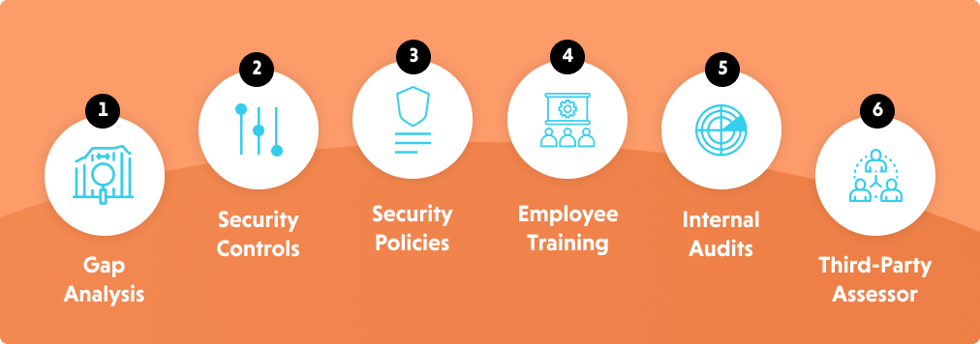
When it comes to achieving compliance with CMMC, there are some key steps that need to be followed. Whether these steps are taken in-house or through a managed IT services provider (who also needs to prove their own compliance) doesn’t matter. At minimum, organizations need to:
A gap analysis helps identify where the organization currently stands in relation to CMMC requirements. This involves assessing existing security controls against the necessary CMMC level and identifying areas that need improvement.
Depending on the required certification level, organizations must implement specific security measures, such as:
Companies must establish and document formal cybersecurity policies, incident response plans, and data handling procedures to align with CMMC requirements.
Cybersecurity awareness training is crucial for all employees, especially those handling CUI. Training should cover topics such as phishing prevention, secure password management, and compliance best practices.
Regular internal assessments help organizations validate their compliance status and identify areas for improvement before undergoing an official CMMC audit.
To obtain certification, organizations must undergo an assessment conducted by a Certified Third-Party Assessor Organization (C3PAO). Preparing for this assessment ensures a smoother certification process.
Understandably, the Department of Defense doesn’t mess around when it comes to cybersecurity. Even if your business simply provides a small component to a company working with the DoD, you need to ensure CMMC compliance.
At the same time, achieving compliance can be complex, especially for small and mid-sized businesses with limited IT resources.
Partnering with a managed IT services provider can significantly ease the burden of CMMC compliance. By leveraging expert guidance, robust security solutions, and ongoing support, businesses can navigate the complexities of the certification process while ensuring long-term cybersecurity resilience.